

 Français
 Español
 Türk

 ++86 19941472007


You can contact to me using this form.
Content
- 1 Direct Answer: Preventing O-Ring Extrusion in High-Pressure Service
- 2 What Causes O-Ring Extrusion in High-Pressure Service
- 3 The Four Numbers That Decide Whether an O-Ring Will Extrude
- 4 Controlling the Extrusion Gap: Tolerances That Matter
- 5 Selecting the Right Hardness for Your Pressure Range
- 6 Anti-Extrusion Rings: When a Backup Ring Is the Only Answer
- 7 Choosing the Right Elastomer: Not Just Any Rubber Will Do
- 8 High-Pressure Service in Real World: Hydraulic Cylinders, Valves, and Wheel-End Units
- 9 Frequently Asked Questions
- 9.1 What is O-ring extrusion?
- 9.2 How can I prevent O-ring extrusion?
- 9.3 What is the maximum gap for a 70 Shore A O-ring at 20 MPa?
- 9.4 Can a backup ring completely stop extrusion?
- 9.5 What is the best material for high-pressure high-temperature service?
- 9.6 Do I need a backup ring on both sides of the O-ring?
- 10 Summary and Action Points
Direct Answer: Preventing O-Ring Extrusion in High-Pressure Service
In high-pressure service, O-ring extrusion is the most common cause of seal failure. It occurs when the gap between mating metal surfaces allows the elastomer to be forced into the clearance under system pressure, causing “nibbling” and immediate leakage. The direct answer to preventing this is to keep the extrusion gap small enough for the material hardness and pressure, select a harder compound when pressure is high, and install an anti-extrusion ring when the gap cannot be reduced enough.
Once you understand the mechanism, the rest is engineering judgment. We serve customers in braking, bearing, and sealing systems where pressure spikes can reach dozens of megapascals. The same rules apply whether you are working with a hydraulic cylinder, a valve stem, or a wheel hub bearing. Our sealing ring product line covers many pressure-rated applications, but the physics of extrusion is universal.
What Causes O-Ring Extrusion in High-Pressure Service
O-ring extrusion is not a material defect. It is a geometric problem that appears when the seal cannot resist being pushed into the space between the two sealing faces.
The mechanism is straightforward. A pressurized fluid pushes the O-ring against the low-pressure side of the cavity. If the clearance between the piston and the gland wall exceeds a critical value for the given hardness, a small portion of the elastomer is forced into that gap. Under repeated pressure cycling, this portion is sheared off, creating a “nibbled” edge and eventual leak.
The most important factors are:
- Gap size – the radial clearance on the exit side.
- Hardness – the resistance of the elastomer to deformation.
- System pressure – the force that drives extrusion.
- Temperature – because softer materials become more deformable at elevated temperatures.
- Material type – some compounds have higher resistance to tearing.
In our field experience with sealing rings for bearings and wheel hubs, extrusion often appears at the leading edge of the seal when a sudden pressure spike occurs during assembly or operation.
The Four Numbers That Decide Whether an O-Ring Will Extrude
Instead of guessing, engineers use a simple set of parameters. The first is the extrusion gap. The second is the seal hardness. The third is the maximum pressure. The fourth is the temperature.
Let's look at how these numbers interact in a typical high-pressure service. The table below gives general guidance for a common nitrile (NBR) compound.
| System Pressure | Maximum Gap for 70 Shore A | Maximum Gap for 80 Shore A | Maximum Gap for 90 Shore A |
|---|---|---|---|
| 3.5 MPa | 0.20 mm | 0.25 mm | 0.30 mm |
| 10 MPa | 0.10 mm | 0.15 mm | 0.20 mm |
| 20 MPa | 0.05 mm | 0.10 mm | 0.15 mm |
| 30 MPa | 0.03 mm | 0.06 mm | 0.10 mm |
| 50 MPa | not recommended | 0.02 mm | 0.05 mm |
Note that these are typical values used in seal design references, not a guarantee for every application. They give a starting point for your own calculation.
The rule is simple: as pressure rises, the allowed gap shrinks. If you cannot control the gap below the limit, use a harder compound or install a support ring.
Controlling the Extrusion Gap: Tolerances That Matter
You can avoid extrusion by machining the metal parts to a tighter clearance. However, tight clearances increase machining cost and can cause metal-to-metal contact. The practical goal is to balance sealing performance with full freedom of movement.
For a shaft or piston, the extrusion gap is set by the bore diameter minus the rod diameter, divided by two. The operating pressure and the seal hardness define the maximum allowable gap. If your current design does not meet that limit, you have three options:
- Redesign the gland to reduce the radial clearance.
- Increase the hardness of the O-ring compound.
- Use an anti-extrusion ring.
In our bearing sealing ring production, we often see customers trying to solve extrusion by just increasing hardness. That helps, but it can shorten seal life because harder seals do not conform as well to surfaces. A better solution is to combine a mid-hardness compound with a backup ring. For wheel hub sealing rings, this combination is common in high-load service.
 Bearing Sealing Ring with Rubber Lip Seal and Iron SkeletonThis bearing sealing ring features a rubber lip seal and iron skeleton, sized 66x49.1x4 mm. It suits high-load wheel hub applications, and pairing it with a backup ring helps prevent extrusion while maintaining seal conformity.View Product →
Selecting the Right Hardness for Your Pressure Range
Hardness is measured in Shore A units. For most sealing applications, 70 Shore A is the default because it offers good flexibility and low compression set. But in high-pressure service, the extrusion gap limit becomes very small, and a 70 Shore A seal may not be suitable.
The table below summarizes typical hardness recommendations.
| Maximum Pressure | Recommended Hardness | Notes |
|---|---|---|
| up to 7 MPa | 70 Shore A | General purpose |
| 7 to 14 MPa | 80 Shore A | Better extrusion resistance |
| 14 to 28 MPa | 90 Shore A | High-pressure hydraulic service |
| above 28 MPa | 90 Shore A with support ring | Back-up ring mandatory in most cases |
In a 90 Shore A material, the seal is less flexible, so the surface finish of the gland and the lubrication must be excellent. If you are in an application with extreme cold, a 90 Shore A O-ring can become too stiff. In those cases, use a support ring to allow a lower hardness compound.
For our rubber sealing rings, we can tailor hardness values to match your pressure and temperature profile. This is why a material supplier should work with you from the design stage.
Anti-Extrusion Rings: When a Backup Ring Is the Only Answer
One of the most effective ways to prevent O-ring extrusion in high-pressure service is to place an anti-extrusion ring, also called a backup ring, on the low-pressure side of the O-ring. The backup ring fills the gap and supports the seal, preventing elastomer from flowing into the clearance.
Backup rings are made from materials that resist extrusion, such as PTFE, polyurethane, or nylon. They are typically installed as a flat ring or a spiral ring. The choice depends on the pressure, temperature, and the media.
For a simple groove, you can install two backup rings – one on each side – for applications where pressure can act from either direction. In a high-pressure hydraulic cylinder, the backup ring must be placed on the side opposite the pressure, so the O-ring rests against it during operation.
If you are assembling a sealing ring assembly that includes a backup ring, the fit between the backup ring and the gland is critical. If the backup ring is too loose, it will not support the O-ring. If it is too tight, it may damage the seal during installation.
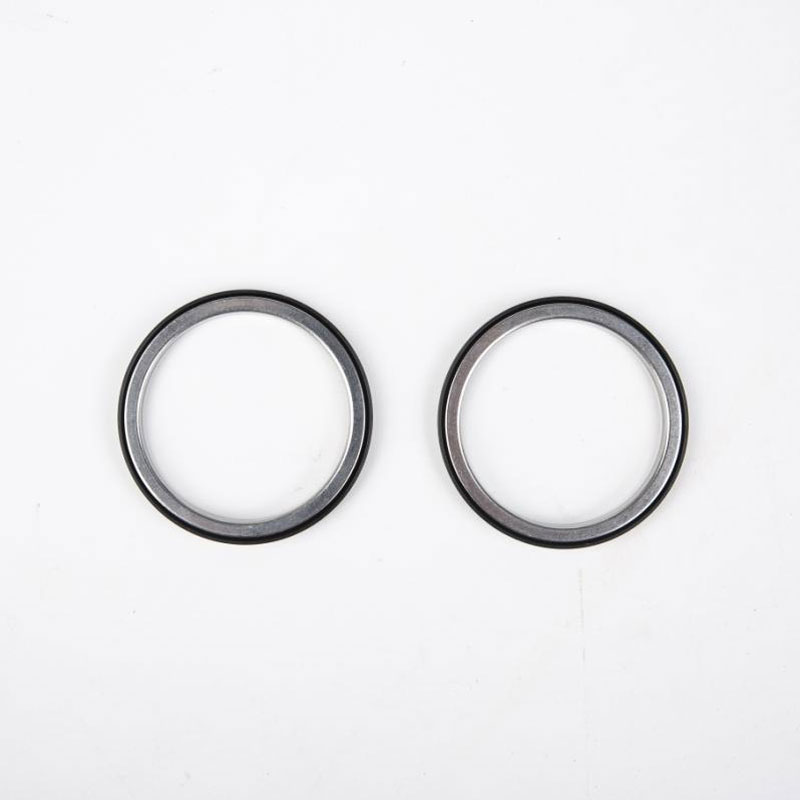 Sealing Ring Assembly with Rubber Lip Seal and SUS304 SkeletonThis sealing ring assembly (75x59.3x3.2 mm) includes a rubber lip seal and a SUS304 stainless steel skeleton. Its design supports proper backup ring fit, critical for resisting extrusion and ensuring reliable installation.View Product →
Choosing the Right Elastomer: Not Just Any Rubber Will Do
Hardness is not enough. The material must resist the fluid, the temperature, and the pressure. Different elastomers have very different extrusion resistance.
Nitrile (NBR) is the most common O-ring material. It resists petroleum-based hydraulic fluids and works well from -30°C to +120°C. For higher temperatures, fluoroelastomer (FKM) can handle up to 200°C, but it is more expensive. Hydrogenated nitrile (HNBR) offers excellent high-temperature and ozone resistance while retaining good mechanical strength.
For high-pressure water or steam, ethylene-propylene (EPDM) may be used, but it is not compatible with petroleum fluids. Always check the chemical compatibility chart before selecting a material. If you need a material that can handle both heat and pressure, HNBR or FKM with a support ring is a common combination.
For more details on selecting an appropriate material, see our article on seal material and design considerations.
 Rubber Sealing Ring with Flexible Sizing OptionsThis rubber sealing ring is available in two constructions: with a sealing ring or with a metal cover, and measures 71x60.5x4.8 mm. It offers a solution for high-pressure sealing where material selection and extrusion resistance are key.View Product →
High-Pressure Service in Real World: Hydraulic Cylinders, Valves, and Wheel-End Units
Extrusion prevention matters differently in different types of equipment. Let's look at three typical high-pressure service scenarios.
Hydraulic Cylinders
In a hydraulic cylinder, the piston and rod seals are subject to high pressure at the stroke end. The rod seal often experiences extrusion during the return stroke when pressure spikes. A backup ring on the low-pressure side is standard. The gland clearance should be held to a very close tolerance. In some heavy-duty cylinders, multiple seals are stacked.
Directional Valves
In valve bodies, the O-ring is often installed in a flat groove. The clearance between the valve spool and the body is fixed by the spool clearance. At pressures above 20 MPa, extrusion can be severe if no backup ring is used. Many valve manufacturers use a 90 Shore A O-ring with a backup ring.
Wheel Hub Sealing Units
In automotive wheel-end systems, O-rings and sealing rings ensure that grease stays inside and water stays outside. Pressure can spike during braking and bearing cooling. When we supply ABS bearing sealing rings, we design the seal to resist extrusion by choosing the right compound and groove geometry. This is a less obvious high-pressure application, but it is one where extrusion damage can cause brake system contamination.
The key is to examine the real maximum pressure, not just the nominal pressure. Transient spikes often cause extrusion even when the steady-state pressure is low.
Frequently Asked Questions
What is O-ring extrusion?
O-ring extrusion is the forcing of the elastomer seal into the clearance gap between two metal surfaces under pressure. The displaced material gets sheared off, leading to leakage.
How can I prevent O-ring extrusion?
Reduce the radial clearance, increase the material hardness, use an anti-extrusion ring, and keep the pressure within the seal's rated capacity. A combination of these methods is most reliable.
What is the maximum gap for a 70 Shore A O-ring at 20 MPa?
Based on typical seal design references, the maximum extrusion gap for a 70 Shore A NBR O-ring at 20 MPa is around 0.05 mm. Harder compounds allow larger gaps, but a backup ring is the best solution.
Can a backup ring completely stop extrusion?
In most cases yes, especially when the backup ring is correctly installed on the low-pressure side. It supports the O-ring and prevents elastomer from entering the clearance.
What is the best material for high-pressure high-temperature service?
For high pressure combined with high temperature, HNBR or FKM with a support ring is a strong choice. The exact selection depends on the fluid compatibility and temperature range.
Do I need a backup ring on both sides of the O-ring?
If pressure can come from either direction, use two backup rings. In single-direction pressure, place one on the low-pressure side only.
Summary and Action Points
Preventing O-ring extrusion in high-pressure service is a matter of controlling the gap, choosing the right hardness, selecting a compatible elastomer, and adding a backup ring when necessary. It is not a one-size-fits-all answer.
Start by calculating the extrusion gap in your design. Compare that to the recommended limit for your material and pressure. If the gap is too large, either tighten the machining tolerances, or use a harder compound, or add a support ring. Remember that every change affects seal life, surface finish requirements, and cost.
When you work with a manufacturer, let them know your maximum pressure, temperature, fluid type, and available clearance. This will allow them to recommend the correct sealing ring design. A well-designed seal can last many times longer than a seal that was chosen only by size, without taking extrusion into account.
